Lighting Vision Supervisor OR Lighting Console Operator
What’s the difference between a Lighting Vision Supervisor and a Lighting Console Operator or Generic Console Operator, sometimes otherwise known as a Board Operator or Board Op? People do ask. Production Managers and Producers like to know.
A Lighting Vision Supervisor is a BBC title. A Lighting Console Operator is a world wide generic title. There is actually a world of difference. And in typical BBC fashion, there is always a very good reason for everything.
If you have a Lighting Vision Supervisor on your show then you are in a very good position indeed. Certainly if it’s a proper LVS, trained at Evesham, brought up through the ranks, taken under the wing of an experienced and respected Lighting Director.
It’s actually very difficult in many ways to compare the two, as they are two very different entities. A bit like comparing a Ford Fiesta to an F Type Jaguar. Yes, they both have four wheels and an engine and will get you from A to B.
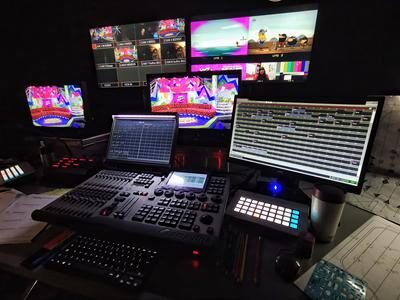

Now, don’t get me wrong. Like with anything in life, there are generalities and exceptions to the rule. There are some people who have a natural ability and understanding without the training. And likewise there are those that have the training but don’t have the understanding.
In general though, a BBC trained LVS has training and a lot of experience of cameras and camera line-up as well as the lighting skills. And again, you can have a lighting console operator, or generic board op as they are commonly known, who has buckets of lighting ability and knowledge as well as the technical knowledge of a particular lighting desk; and you can have another one with the same skills on paper and good knowledge of the lighting desk, but who has no real understanding of lighting. That doesn’t necessarily make them a bad console operator but if you understand lighting and you understand cameras, then you are already in a different league.
The big separator for me is when the person operating the cameras and the person operating and balancing the lighting are talking the same language. You might think that is a given in a professional environment. But sadly it is all too common for that not to be the case. The huge advantage of a BBC, or otherwise, trained Vision Operator and a BBC trained Lighting Vision Supervisor is that the LVS has all the training that the VO has had, and with a lot of additional experience to boot; hopefully that is the case anyway. The LVS and the VO are then working seamlessly as one cohesive unit. A lot does not even need to be said as they are both understanding each other without wasted words.
It’s also worth distinguishing here between the generic console operator and the moving light operator or programmer. Generally the LVS does the generic fixtures, the most important lighting balance in effect, as those are the lamps lighting the faces of the people. The modelling and balance on the faces is always the most important thing as in the world of TV we are always looking at people in big close up shots. The LVS can in fact do the moving lights whilst a less senior operator looks after the generic desk. That means that person has to program the moving lights and also supervise the running of the generic desk, but it can be done, and indeed has been done on many occasions.
The final pictures are the work of the Lighting Director, who is in overall charge, coupled with the contribution of the LVS and VO, both of whom are a vital part of the team and the creative process. If there is one weak link in that chain, the whole process can quickly fall apart. If you have the right people in that team then it can be a joy and an eye opener to watch.