Flying Pig Systems Archive Memories – The History of the Wholehog 2

The History of the Wholehog 2.
My first encounter with the Wholehog 2 came in September 1998 whilst at the PLASA exhibition at Earls Court. Mike Falconer was there demonstrating it. He was undoubtedly one of the best demonstrators in the business but even so, I think I knew within about two minutes that this was the desk I had been looking for, ever since the first time I had been involved with the programming of ‘intelligent’ moving lights back in 1993. Back then I was one of the very first people to have Vari Lite VL5’s in a TV studio in the UK. Studio A in Glasgow had a Galaxy of course, one of the best generic desks ever made, and a far cry from the JP20 which was the very first Strand desk I ever used, but it was also kitted out with a Gemini 2 with two playbacks. I remember painstakingly working out a system of groups that allowed me to program the VL’s and play back some quite complex music routines on those two playbacks. It was groundbreaking at the time and also challenging but a huge amount of fun.
Next came the MA Scan Commander which I used for the next few years from roughly 1994 to 1998. It was okay, but a bit awkward and very limiting. I did a lot of shows on that with VL5’s VL6’s and Golden Scan’s amongst others.
So when September 1998 rolled around and we were organising our annual pilgrimage to Earls Court, I was very excited by the news I had heard on the wires of the up and coming product from Flying Pig Systems.
I was certainly sold on the desk after Mike’s initial demonstration, but then of course you have to persuade the powers that be to also believe in your great idea to spend a rather large amount of money on a new product, particularly when I didn’t just want one of them, I wanted two… of course… one up in the gallery and one on the studio floor which also acted as the backup.
Anyway, Santa was very good to me that year and the new toys duly arrived in Studio A’s lighting gallery, along with a personal visit by Mike, at the very beginning of December, just in time to record that years series of ’50:50’, a full on children’s game and quiz show with multiple setups, lots of movers, LED’s and a variety of MIDI triggers coming from the various games being played out on the floor. Of course there was the obligatory music number and then I remember the quiz round where any one of 50 children on each team could be picked out at random and spotlighted using a Mac that was sweeping over their midst as the random number was chosen before settling on the chosen victim.
So, all in all it was quite an introduction to Hog 2 programming, learning the desk whilst doing a whole series of ‘as live’ recordings. It certainly was very reassuring to have Mike looking over my shoulder, answering my endless questions and helping me to successfully put the first show together. But what a joy it was to program and operate. That is the beauty of the Hog and Flying Pig. Having a desk designed by three people who actually understood lighting as well as computers made the Hog an absolute shining star in the ever evolving world of computerised desks, the vast majority of which were really unbelievably awful tools for attempting the job in hand. So a great many thanks are due to Captain Beaky and his band.
I used the Hog 2 for many years after that on countless numbers of shows and loved every minute of it. There was nothing that you couldn’t do with that desk. Creativity wasn’t compromised at all and that was the real beauty of it. The custom waveforms for the FX generator opened up even more opportunities to make effects for certain lamp types. I discovered a PC software program called, I think from memory, Midi Ox which allowed you to patch incoming MIDI notes to strings of outgoing notes that the Hog could understand. A remarkably useful tool that I made very good use of. I also remember building a custom made work surface for the second desk that I used for my programming on the studio floor, and the boys in the mechanical workshop built me an adjustable hood to keep the glare of the lights off the touch screens. The things you could do back then..!
I think it was another visit to PLASA one year when Hugh Davies-Webb introduced me to the equally exciting Catalyst media server that naturally integrated with the Hog by way of the fixture personalities and thus became a seamless part of the show. The possibilities, not to mention time spent programming, became endless.
A few years after my introduction to the Hog 2, and after a lot of interaction and feedback to the Flying Pigs, I did some beta testing on the Hog 3 in the autumn of 2002, although it would be a number of years later before I actually got to use the Hog 3 on a real show. I remember one year at PLASA twisting Beaky’s arm to give me one of the very few Hog 3 polo shirts that were in existence. And I still have that shirt to this day along with a lot of other Hog and Pig paraphernalia including my treasured cap that I always seemed to wear whilst programming, and the original manuals, t shirts, boxes and boxes of show discs and goodness knows what else. I am a hoarder and very sentimental, what can I say.
As far as I know, my two original Hog 2’s are still up at the BBC in Glasgow, lying in a room somewhere, sadly unused for many years now. It would be great to try and find them and see if they still work and to have another play with what is an iconic and life changing piece of lighting history.
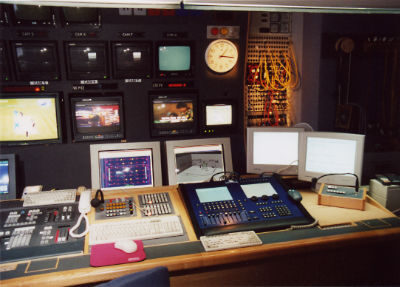
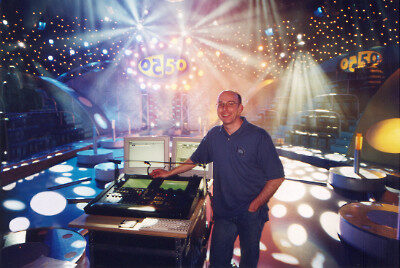
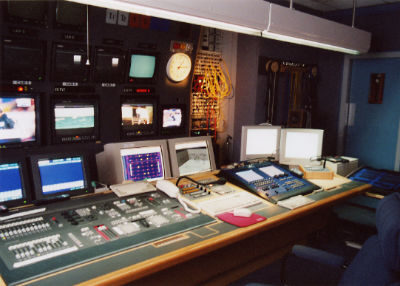

Photographs from top, left to right: Studio A Lighting Gallery at Queen Margaret Drive Glasgow in 2002 with the Hog 2 and the WYSIWYG computer. Adrian on the set of ’50/50′ with the WholeHog 2. Another view of the Lighting Gallery with the ADB Vision 10 generic desk foreground, the WYSIWYG computer and the Hog 2 with the DMX patch bay in the background.
This article was originally written in 2019 at the request of and for the Flying Pig Systems Archive website. It was never published due I believe to the pandemic.